

In honor of Thanksgiving, and in remembrance of my ancestors on the Mayflower and those who settled in the Colonies afterwards, I thought a little look at something that threatens part of what they built might be in order.

You’ve heard the adage “Learn something new every day”, the underlying assumption being that doing so is a good thing and that it will enrich your life.
I’m not so sure.
Sifting through the noise from the recent mid-term elections, one irksome sound- like nails on a chalkboard, or Kamala Harris’s laugh- persists in grabbing my attention: the incessant Democratic refrain after every election to do away with the Electoral College.
I’ll be honest, I’m not a constitutional scholar and I don’t play one on TV, having at best a rudimentary understanding of what the Electoral College actually does. In the process of writing this post, I’ve learned a bit more about it. Yeah me: I learned something new. Now it’s your turn. Sorry about this.
First, the basics: contrary to what the bleeding hearts on TV and JewTube tell you, the United States is not a direct Democracy. It’s a Representative Democracy and a Constitutional Republic. That’s how it has been since day 1, and it means we hire people (by voting for them) to go to Washington to do the heavy lifting and act on our behalf. Well, that’s what they are suppose to do anyway.

When voting for the presidential ticket, we are actually instructing electors at the state level, who then go to Washington and vote for the president on behalf of the people of the state from which they come. There is no national popular vote for president. There never has been. The number of electors per state is set in the Constitution, and how the electors are selected is determined by each state. Most states, but not all, go with a winner-takes-all approach, and the electors from that state go to Washington and vote accordingly. The number of electors per state is determined by the number of Representatives they have in Congress, which in turn is determined by the state’s population. Thus, more populous states do have a greater influence than sparsely populated states, but all states play a role and have a say.
It’s not a perfect system by any means, as any conservative on the West Coast will tell you. Oregon is a great example: the three largest population centers along the I-5 corridor and clustered in the northwestern part of the state- dominated by liberals – have not voted for a Republican presidential candidate in 40 years. As a consequence, most of the southern part and the entire eastern half of the state- which has voted Republican every time- have had to watch their state electors vote for the Democratic candidate in every election- including such stellar examples as Mike Dukakis, Hillary Clinton, and Kamala Harris. Being a conservative in a state with cities overrun with libtards can be a tough pill to swallow.

Now imagine that problem at a national level. That is what doing away with the Electoral College looks like.
For example, Democratic Socialist New York City alone has a larger population than Wyoming, Vermont, Alaska, North Dakota, South Dakota, Delaware, Rhode Island, Montana, and Maine, combined. The three most populous cities, New York, Los Angeles, and Chicago- all controlled by Democrats and all with huge numbers of immigrants (legal and otherwise)- have a combined population greater than the 13 least populated states, combined.
You can see why this is a horrible idea, and why the Democrats favor it. They are trying to rig the system so they win every time.
They complain about the electoral college not representing the will of the people as expressed by the (constitutionally meaningless) popular vote, and yet, in the last 100 years, exactly TWO elections have seen a president elected with an electoral win and a popular vote loss: George Bush in 2000 against Al Gore (remember what a cluster “F” that was), and The Donald in 2016 against Billary Clinton. That’s it. “Reforming” the Electoral College isn’t about righting a wrong. It’s about controlling the future and taking what little control voting Americans actually have away from them so that the deep blue bastions of social justice warriors and limousine liberals can dictate terms to the rest of the country.
Of course, doing away with the Electoral College would be difficult because it requires a constitutional amendment. Trying to change it has become something of a national pastime in Washington: Since its inception in 1787, over 1,000 amendments have been proposed, with no luck.
Which brings us to today. The Democrats, being clever bastards and having no regard for the will of the people, think they have found a way to do away with the electoral college in effect if not in fact. Instead of going through the motions to change the constitution- they will go around it.
Introduced in 2006 The National Popular Vote Interstate Compact (NPVIC) is an agreement among a group of U.S. states and the District of Columbia to award all their electoral votes to whichever presidential ticket wins the overall popular vote in the 50 states and the District of Columbia, regardless of which ticket won more votes in their individual state/district. Catch that last bit? It doesn’t matter how you vote or who wins your state: whoever wins the popular vote nationally gets the electors. Because it is, technically, still using the electors to select the president, it doesn’t do away with the electoral college and thus doesn’t require a constitutional amendment. Very clever. And very good for them: Presidential candidates can focus their efforts on the three or five largest cities in the country (currently controlled by Democrats), and let everyone else go to hell.
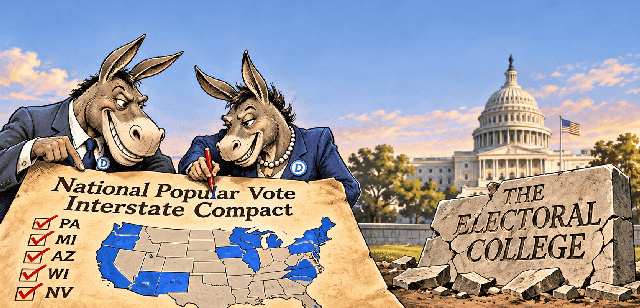
Of course, to be a viable proposition, there must be enough states with enough electors who have joined the NPVIC, and the Compact only goes into effect when this happens. However, among the many regrettable outcomes of last week’s midterm elections is a significant increase in the number of states in which Democrats gained governing trifectas- that is, total control of the state government. Specifically, they took control of state legislatures and governorships in Pennsylvania, Michigan, Arizona, Wisconsin, and Nevada.
If all five of the states listed above decide to join NPVIC, then the total number of electoral votes controlled by the compact’s members would increase to 283, thirteen more than the 270 needed to bypass the Electoral College, and the Compact goes into effect. The 18 states that have already joined NPVIC are the usual suspects: California, Colorado, Connecticut, Delaware, Hawaii, Illinois, Maine, Maryland, Massachusetts, Minnesota, New Jersey, New Mexico, New York, Oregon, Rhode Island, Vermont, Virginia, Washington, and the District of Columbia. These 23 states would, according to the stipulations of NPVIC, choose the president without the consent of the other 27 states or their voters.
Of course, such shenanigans could and probably would be challenged. For example, Article I, Section 10, Clause 3 of the Constitution states: “No State shall, without the Consent of Congress … enter into any Agreement or Compact with another State.” But, thanks again to the recent mid-term election, guess who controls Congress. Think of the confusion and chaos this could bring during an election year. Another election decided, eventually, in court. Or civil war. It will make the curious events of January 6 look like amateur hour.
There is a much simpler solution, and all of this can be avoided if the Democrats were truly interested in “one person, one vote” (which, of course, they aren’t). It could be accomplished without NPVIC. The states could pursue genuine reform by simply choosing to allocate their electoral votes proportionally. Nebraska and Maine have already changed their allocation systems to something approximating this method, and it involves no conflict with the Constitution.
It would, however, reduce the enormous electoral power wielded by the largest Democratic states.
In this revised system, for example, in California- which, by the way, contains the largest number of Republicans of any other state- more than 20 of its 54 electoral votes would go to the “Grand Old Party” (the Republican’ts) instead of all 54 going to the communist du jour as the current winner-takes-all system allows. This is why no Democrat-controlled state would dream of going to a fully proportional system: It might actually reflect the will of the voters. They want to shift more power to heavily populated, Democrat-dominated regions and keep the electoral advantage they already possess in large states like California, New York, and now even Texas.
The NPVIC is just another Democrat scheme to rig the game, and they may now have the numbers to do it. Of course, the Democrats would never adhere to any pact if they believed a Republican would capture the “popular vote” but lose the Electoral College. The National Popular Vote Interstate Compact exists solely to steal an election from a GOP candidate should the need arise, such as it did in 2000 and 2016. And maybe 2028.
The shenanigans continue, and the attempt at subversion is real.
Amerika Erwache!
SUBSCRIBE TO THIS BLOG
(It’s free, and mostly painless)

Leave a Reply