

Happy New Year. Heck of a way to start it.
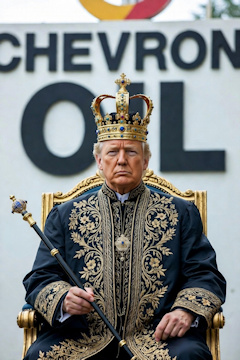
I guess I’m still trying to get my mind around 2025, so maybe once more unto the breach. But of course, 2026 is knocking hard on the door, so let’s get the elephant out of the room: I wrote about Venezuela a month ago. Other than Trump finally admitting it was all about oil and not drugs, nothing much has really changed: he’s still using our taxpayer funded military to further private corporate interests. Hard stop. I know some people are really excited about getting Maduro out of office. Maybe Chevron and other big oil interests running the country will turn out to be a positive for the Venezuelan people, though I wouldn’t bet on it. But here’s the thing: even if Maduro was the worst person in the world, repeat after me: “We’re not the world’s police!” For more in-depth coverage of why Venezuela is about nothing more than Trump paying off his campaign debts, be sure to read or listen to last month’s post from December 3rd, titled “I’m Tired Of Being Lied To.”
All of this makes what follows even more interesting: it underscores how little has actually changed. We’re still being spoon-fed a carefully crafted narrative, as I hope to show below.

I remember when I turned 25 how weird it felt to be able to say I was a quarter-century old. Now we’ve turned the page on 2025 (well, on the calendar anyway. The fallout from the last year alone will take years to sort out), and I completely missed that we have just completed the first quarter of this century.
Then I came across the following article. It not only served to remind me of this calendar event, but in a way, started to answer a question I am asking more and more frequently as I get older: “What the hell happened?” How did we get here?
I’m working on a longer post for the near future that also looks at these questions by drilling down into one key aspect of our society’s implosion. But this shorter article is interesting for two reasons: It provides a “30,000 foot” view of the last quarter century, serving to at least get us on the map and into the conversation; and it misses or avoids significant features of the landscape, perhaps deliberately, which in its own way also speaks to our question. I’ll circle back to how that is so at at the end of this post.
But let’s start at the beginning. What follows was published in the Wall Street Journal on December 30, 2025. It is a short article, so I will share it in its entirety:
At the conclusion of the 20th century, America’s leadership was uncontested. We had the world’s strongest economy and most powerful military, bolstered by an unequaled system of alliances. Americans from the bottom to the top enjoyed rising real incomes. The federal budget ran a surplus for four consecutive years, from 1998 to 2001. Despite their differences, the political parties were able to reach agreement on important issues, including on fiscal policy, education, welfare, the environment and protecting Americans with disabilities.
An era of folly began in the new century. Leaders of both political parties supported China’s entry into the World Trade Organization on terms that allowed a flood of cheap imports, contributing to a loss of 5.7 million manufacturing jobs (one-third of the prior total) between the end of the Clinton administration and January 2010. Few displaced workers received help making the transition to new jobs, and many suffered a decline in their standard of living, laying the foundation for an era of populist resentment.
The 9/11 attacks devastated the nation. President George W. Bush’s overreaction was also damaging. Any president worth his salt would have struck back against the terrorists who killed thousands of Americans. But the Bush administration went much further, launching a prolonged war in Afghanistan and Iraq and eventually proclaiming the grandiose goal of “ending tyranny in our world.” By focusing so much attention and resources on the “global war on terror,” America all but ignored the rising threat from China, whose economic gains were translated into a massive military buildup. The Mideast campaigns soured many Americans on international engagement.
America’s fiscal situation also deteriorated. In January of 2001, the Congressional Budget Office projected that the budget surpluses of President Bill Clinton’s second term would continue throughout the next decade, totaling $5.6 trillion and erasing the national debt. Nineteen months later, the CBO predicted that big tax cuts, higher spending and lower economic projections would eliminate the surplus for 2002 and several years thereafter. As it turned out, fiscal 2001 was the last time the federal government ran a budget surplus, and the chance that the debt will ever be erased is slim.
Economic mismanagement extended to financial markets. Federal Reserve Chairman Alan Greenspan and other financial experts argued that self-interest would lead banks and other organizations to avoid taking on excessive risk. After the collapse of major Wall Street firms triggered a financial crisis and a punishing economic downturn, Mr. Greenspan admitted error. But the damage was done. The recession’s effects lingered for years, and the credibility of market systems worldwide took a hit from which they haven’t fully recovered.
By 2010, polarization had sharply increased, diminishing the federal government’s ability to act unless a single party controlled the presidency and both chambers of Congress. Faced with legislative opposition, presidents of both parties resorted to governance through executive order and regulation. The resulting expansion of presidential power, which President Trump has accelerated, has distorted our constitutional order.
Gridlock in Congress has allowed many problems to languish unsolved. Efforts to deal with fiscal policy, entitlements and other critical issues have floundered. Take one example: Mr. Trump can enforce current immigration laws, but long-term immigration reform would require new legislation.
The Covid-19 pandemic triggered another round of mismanagement. Mr. Trump deserves credit for fast-tracking vaccine development, but his advocacy of untested remedies weakened public confidence in government recommendations.
The Biden administration made matters worse. Its public-health measures harmed the economy, education and individual liberty. As a result, confidence in experts and institutions suffered a blow from which it will be difficult to recover. Some European countries did better, reducing Covid-related deaths without shutting down economic and social life or closing schools for an extended period.
Today, pressures are mounting on every side. Young families can’t afford to buy homes. Americans 80 and older, whose numbers are projected to increase from 14.7 million to nearly 23 million over the next decade, will put unprecedented pressure on our healthcare system. Unless Congress takes action, the Social Security and Medicare trust funds will run out of money by 2033. Mr. Trump has weakened our allies’ confidence in America’s support, and China’s military buildup, as outlined in a recent Defense Department report, is deeply concerning.
This century had a rocky start, but that doesn’t mean Americans can’t turn things around. We need political leaders to take on these tough problems and bring both parties to the table to solve them. Only then will America’s 25-year decline end and recovery begin.
At first I thought this was a good summary of the last 25 years, and maybe you did too. It seems a respectable thumbnail sketch of the first quarter of this century.
But the more I thought about it, the more I didn’t like it. In fact, I’ve come to the conclusion that it is a sterling example of one of the primary problems in this country: the easy willingness of talking heads with public platforms to tell lies, if only by the failure of omission, and muddy the waters of our national discourse in the service of myopic partisan agendas while offering no real solutions. In short, the article, published by one of the leading media outlets in this country, at first seems straight-forward, well-intentioned, and even-handed, but is actually deliberately misleading, disingenuous, and a subtle attempt to rewrite the historical narrative.
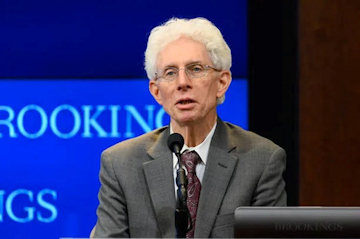
Acknowledging that correlation does not necessarily imply causation, let us consider a few facts: the author of the article, William A. Galston is Jewish and holds the Ezra K. Zilkha Chair in Governance Studies and is a senior fellow at the Brookings Institution.
The Brookings Institution, in turn, is a liberal-leaning think tank which, along with the Council on Foreign Relations and Carnegie Endowment for International Peace, is generally considered one of the most influential policy institutes in the U.S. It traces its history to 1916 and contributed to the creation of such dubious institutions as the United Nations and the Marshall Plan. The annual think tank index published by Foreign Policy ranks it the number one think tank in the U.S., even though it has been found to have received payments from foreign governments while encouraging American government officials to support policies aligned with those foreign governments’ agendas. Its largest foreign donor is often Qatar, and in 2022, Brookings president John R. Allen resigned amid an FBI probe into lobbying on behalf of Qatar.
Again, this is who author William A. Galston works for. He was also Deputy Assistant for Domestic Policy to U.S. President Bill Clinton, the same fella that gave us NAFTA and all the economic and social damage that caused, which Galston doesn’t mention.
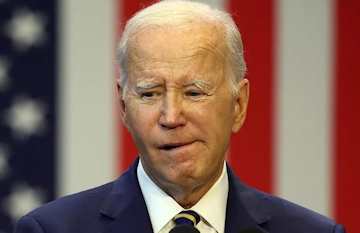
So with that background information in mind, if we look at the article again, it becomes all the more noteworthy what is missing: no mention of the DEI sickness infecting American culture and its insistence on releasing feral criminals into the civilian population; he mentions Trump enforcing immigration laws, but neglects the willful abandonment of those laws by previous Democratic administrations; he rightly blames the decades-long war in Afghanistan and Iraq on Bush, but neglects to mention it was equally poorly managed and prolonged by Democratic presidents; there is no mention of the BLM scam and the damage and loss of life it caused in many major American cities while being cheered on by politicos in Washington; no mention of government encouraged censorship on social media platforms, nor of government agencies dictating content to traditional media outlets; no mention of the increasing influence minority lobbyists like AIPAC have on our politicians, but then again, he’s Jewish, so why would he; not a word about covering up a mental deficient in the oval office by an entire political party and the national media; etc.
I realize Mr. Galston is looking at large governmental trends. But all of the neglected points mentioned above are also a part of, or a result of, those same trends. When the government willfully ignores some laws and conducts draconian enforcement of others, the rule of law itself is called into question. In short, our government has undermined its own authority. When people such as Mr. Galston engage in the national political discourse and only see what their rose-colored glasses let them see, the discourse itself becomes more partisan and, frankly, dishonest.
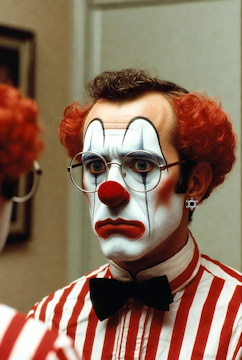
Mr. Galston blames the decline we have witnessed over the last 25 years on “misgovernment” and poor leadership. And while all of the points he makes are valid, I would argue that he needs to spend more time in front of the mirror. It hasn’t been “misgovernment”- it’s been partisan agendas over the common the good. It’s been the devolution of the national media into hackneyed shills for the two political parties. By highlighting vague partisan shortfalls without truly holding anyone accountable or the selfish agendas that drive them, he is perpetuating the problem: he is adding more noise in the already deafening echo-chamber that is American political discourse. It’s another example of people with influence and a national media platform using lots of words to say nothing in an effort to prop-up the existing broken system. It is another tool in the “Rule by Obfuscation” toolkit.
Therefore, I would modify Mr. Galston’s last few sentences. He is arguing for the existing system to fix itself. It won’t. I would replace:
“This century had a rocky start, but that doesn’t mean Americans can’t turn things around. We need political leaders to take on these tough problems and bring both parties to the table to solve them. Only then will America’s 25-year decline end and recovery begin.”
With:
“This century had a rocky start, but that doesn’t mean Americans can’t turn things around. We need to move past the empty, self-serving rhetoric coming out of Washington paid for by multinational corporations. We need to hold criminals accountable whether they are on the subway or in the halls of Congress. We need a government that is truly for the people, our people, and not the donor with the deepest pockets or minority foreign interests. We cannot expect our current system to self-correct. It would be like expecting a car on the side of the road with a blown head-gasket to fix itself, or akin to putting a bottle of booze in front of an alcoholic and telling him to take just one sip. It simply isn’t going to happen. We need to seriously discuss fundamental changes to the system itself. Only then will America’s 25-year decline end and recovery begin.”
Amerika Erwache!
SUBSCRIBE TO THIS BLOG
(It’s free, and mostly painless)


Leave a Reply