
I know there are people who read this blog or listen to the podcast that generally support Trump, even if they disagree with some of his decisions. This post is not for you. Instead, it is geared more toward people like myself who felt they had to hold their nose in the last election and vote for him because the alternative, almost as if it were by design (wink wink), was completely beyond the pale. And I confess: after the madness of the Biden-autopen Years and its run-amok wokeism, I harbored some small spark of hope that Trump would refocus our national energies on taking care of our own, end the brown invasion, stop the wanton military adventures for profit that our military has been engaged in for the last fifty years, and, in short, help the White working class.
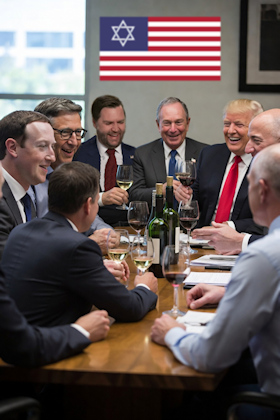
As is now apparent, this was not to be. True, some progress has been made on stopping and reversing the invasion, but only by drips and dribbles. Everything else has been a disappointment. He has done little more than revitalize the neo-communist Left by engaging in needless tradewars (speaking of which, where is that tariff check I was promised?), driving up healthcare costs, exploding the national debt, and paying back campaign promises to big oil, by invading Venezuela, and to Israel, by helping them demolish Gaza. The wheels came off the wagon when he attacked Iran for the sole purpose of providing cover for the Israeli land-grab in Lebanon and the creation of business opportunities for his son-in-law Jew Jared Kushner and record profits for “defense” contractors. Funny how you don’t hear about Ukraine anymore.
von Clausewitz famously stated that “war is merely the continuation of policy by other means,” emphasizing that war is a tool used by states to achieve political objectives. But when those objectives are for the sole benefit of a small cadre of cronies and family, to say nothing of another foreign power, one must question means.
I should know better, of course: The two parties in this country are sides of the same coin that resides in the deep pocket of shadowy elitists and special interests. We are simply grist for their mill. It’s all very depressing. Indeed, at times, I find myself sighing in frustration and wondering if anything I do matters. We railed against the Libtards and their Jewish handlers during the Biden-autopen Years only to find out that Trump is really just another shill for Israel, the Military Industrial Complex, and Bohemian Grove billionaires.
As is often the case, a recent article on the Counter-Currents website caught my eye and seemed to speak to my concerns. In a way, it felt like a much needed pep-talk. And it is for that purpose, a pep-talk, that I want to share it just in case others of our mindset feel as I do.
I don’t agree with everything it says, particularly as it regards J.D. Vance. Race-traitor Vance is obviously just another tool for global elitists, primarily homosexual and “aspirationally Jewish” Peter Thiel. But the overarching point of the article, that we must continue to work toward our goals because no one is going to hand them to us, is worth remembering. On the whole, I think it is an encouraging pep-talk, and it is in that vein that I wish to share it.
Without further ado:

Trump Disappointment Syndrome
Greg Johnson Apil 10, 2026
A lot of people are down in the dumps because of Trump’s shocking betrayals on immigration, the Epstein files, and especially the expanding debacle in Iran. Here are a few words of consolation. Things aren’t that bad.
As a White Nationalist, my political goal is to restore white homelands ravaged by globalization, low white fertility, and non-white migration. Our ranks are steadily growing, but we remain a political minority. Until we are no longer a minority and have the power to implement our preferred policies, we must content ourselves with influencing existing parties to adopt policies we like.
Our natural political constituency is white people who vote for center-Right parties, especially nationalists and populists, as opposed to globalists and neoliberal elitists. Such politicians include Viktor Orbán, Georgia Meloni, and Donald Trump.
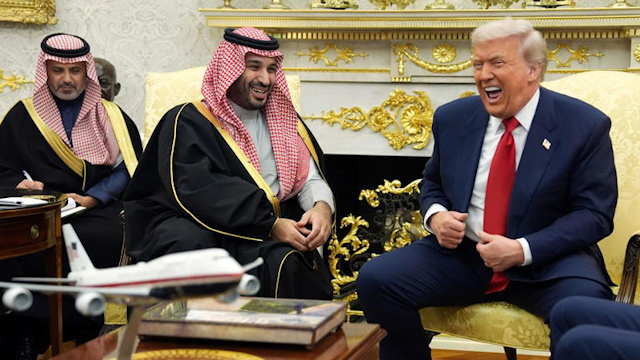
One shouldn’t expect too much of such politicians. They only want some of the things we want, and frankly they’d be horrified by the rest. Moreover, they will speak to and make deals with our enemies, but they will barely acknowledge our existence. We can dispense with them once we have power. But until that time, they’re the best we have.
Orbán is by far the best of the lot. Meloni is the biggest disappointment. Trump is a very mixed bag. He has done many things we would do if we had power: restrict immigration, ramp up deportations, and roll back anti-white discrimination.
But Trump’s megalomaniacal foreign policy blunders, including two wars on Iran at Israeli behest, have wrecked vital alliances, sent the global economy into a tailspin, and shredded the electoral coalition needed to perpetuate his policies. At this point, it seems almost certain that the Left will return to power and reverse everything good he accomplished.
It’s all very depressing.
But I want you to notice something about the political scenario above. The agents are the Left, the center-Right, and mainstream national populist politicians. We can also add in the Jewish lobby, the oligarchy, and various foreign powers.
But where do we fit in this picture? Apparently, we’re just helpless, passive spectators. If that’s how we see ourselves, no wonder so many people are depressed. It feels bad to be helpless and passive.
But there’s another way to look at this. We’re not mere spectators. We’re agents here. And we’re not powerless either. Now, I will grant that building White Nationalism with no money and no power is much harder than having it handed to us by others. But, (1) people who don’t want White Nationalism were never going to deliver it anyway, so even if they gave us a good head start, the greater part of the work was still going to be ours, and (2) taking stock of what we can do and making a plan to do it is better than moping around and feeling powerless and hopeless.
The Ancient Stoics taught that there are things you can control, and there are things you can’t. The first step toward wisdom is discerning the difference. White Nationalists have very little control over the world, because we lack numbers, money, and political power.
But we have a lot of control over our attitudes and expectations. If you want things that you can’t have, you are bound to be defeated. Unrealistic expectations are a major source of disappointment. And disappointment is one of the main impediments to discovering the things you can control and expanding your power over them.
There’s a strange phenomenon on the Right that I call “Imaginary Friend Syndrome.” I first noticed it in 2008 when White Nationalists convinced themselves that Ron Paul was a secret friend. “Ron Paul gets the JQ. That’s what’s really behind his anti-interventionism.” Then, four years later, Ron Paul was back and Mitt Romney joined the Secret Friend Club: “Look at Romney’s cranial index. Look at his big, beautiful family. Look at his ‘power point.’”
I mocked this at the time, but it has only gotten worse.
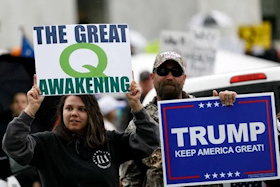
The biggest and most baleful examples of Imaginary Friend Syndrome on the Right today are the Based Putin/Based Russia crowd and QAnon. QAnon didn’t just imagine Trump was our guy. It sold millions of people on the idea that Trump had a whole team of Superfriends fighting alongside him against the “Deep State.”
I believe Imaginary Friend Syndrome is a coping mechanism for dealing with a feeling of powerlessness. But you don’t gain power from deluding yourself. It is fun to imagine that you have friends in high places. But you can only gain power from a cold, objective look at reality.
If you imagined—even slightly, even for a minute—that Trump is our friend, you were setting yourself up for needless disappointment. So pull that disappointment up by the roots.
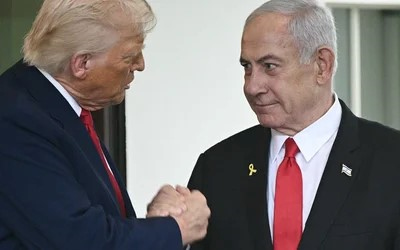
Trump isn’t a White Nationalist. He was never a White Nationalist. That was never going to happen. He wants some of what we want in the short term. But he doesn’t have a long-term vision of society, and if he bothered to articulate it, it would be a happy rainbow in which minorities act white and grateful, like something from eighties sitcoms and buddy movies. He’d be horrified by the idea of restoring white homelands. Ultimately, only White Nationalists can create White Nationalism, because only we want it.
It would be easier if you are like me and regard Trump coldly, simply as a tool. (And let’s face it, that’s how he regards us.)
At best, he was a tool implementing policies that we would have implemented, thus giving us a taste of victory long before we actually attain power.
Even if all Trump’s positive achievements as president are erased, his greatest gift to us may have happened on that day in 2015 when he announced his candidacy. In a single stroke, he changed the parameters of American politics by questioning the value of unrestrained economic globalization and Third World migration. Millions of Americans, overwhelmingly white, were being harmed by these policies. But their complaints were ignored by the political establishment until Trump came along.
Barring that, Trump is at the very least—to quote Charles Murray—our “murder weapon” against the American political establishment.
The reigning policies in a society are the ones you don’t get to vote on, because they are embraced by the whole political establishment. Trump was hailed as a tribune of the people and denounced as a traitor to his class because he broke ranks on globalization and immigration. Trump opened a space in American politics for nationalism, populism, and white identity politics. He proved that it is a winning formula.
That’s the sense in which Trump was a murder weapon against the political establishment. And, as any wise guy will tell you, once you use a murder weapon, you need to drop it and walk away.
Establishment Republicans would very much like to go back to business as usual, but that won’t happen, for three reasons:
- “Business as usual” is destroying America. Once Trump is gone, multiculturalism won’t magically start working. Liberalism, globalism, open borders, and pandering to crazies, criminals, and morons won’t make society better. More business as usual just means more destruction. More destruction means more people searching for credible solutions. And that’s where we come in. We have the solutions. The failures of the system—globalization, multiculturalism, anti-whiteness, immigration—are the primary forces driving the rise of white identity politics. If the system intensifies these policies, they will intensify the reaction, which would be us. And now we can add Trump’s betrayals to the list of factors driving people toward us.
- The other main factor driving the rise of white identity politics is that we are converting people to our way of thinking. We are winning the battle of ideas. This can be measured by opinion polls, electoral shifts, and web traffic to alternative sites. There are more people getting into the fight every day, and not just passive consumers of “content” but creators and activists.
- Whether from principle, opportunism, or some blend of both, new national populist politicians are emerging who understand identitarian issues far better than Trump or Nigel Farage. Rupert Lowe in the UK is the best example. J. D. Vance is an even better example, because he is a heartbeat from the US presidency already. But that’s a hard thesis to sell in the current climate. Vance may be too tainted by association with Trump. He may have “played the game” too well with the ruling powers. So it may be a foolish use of my social capital to plead his case.
In sum, Trump was not our last hope. I wish he had done more for us as president. I hope the good things he has done won’t be reversed because his stupidity will return the Left to power. But the best thing he has done for us—creating a political space for nationalism and populism—will not be undone.
The rest is up to us. But it has always been up to us. In the end, only White Nationalists will save our race, because we’re the only people who want that. And there are more of us every day. New and more receptive political figures are emerging, and many more are to come.
Yes, the system still has enormous advantages in terms of guns and money, but truth and justice are on our side, and ultimately those matter more.
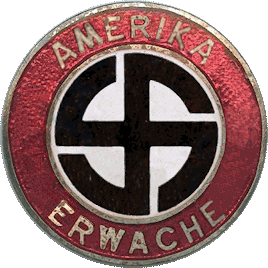
Amerika Erwache!
SUBSCRIBE TO THIS BLOG
(It’s free, and mostly painless)



Leave a Reply