

First, apologies for the intermittent postings. I, sadly, work in the financial services industry– so you can imagine what the run-up to April 15th is like for me. Add to that the current state of the market and economy, and…well… you get the idea.
In any event, how about something not related to Trump’s War in Iran. Consider this a public service announcement.
Whenever possible, I like to get my information from “the horse’s mouth.” Primary source information is usually the most reliable. So when Israel’s largest newsgroup, Haaretz, said that Israel is using our cars to spy on us, I immediately took note. If anyone would know, they would.

A recent article titled “Your Car Is Spying on You – and Israeli Firms Are Leading the Surveillance Race”, published on February 16, exposed the tip of the iceberg. As the article says, “Israeli companies have developed and are selling advanced cyber tools that can hack into the tech of your car and use it to collect intelligence on you.”
We’ve long known that our phones, and devices like Alexa, monitor our movements and conversations in real time unless you actively take measures to shut that capability down. I, of course, go to some pains to ensure I am not being monitored. My wife, however, has a more lassie-faire attitude and as a consequence it is not unusual for her to receive targeted advertising after discussing a subject with her friends. The digital ear is always on.
But now it is not just our phones. Increasingly, it is any device that connects to the internet or has a sim card. This includes your car, which has become essentially a smart-phone on wheels. In the intelligence industry, this is known as CARINT— car intelligence. And the leaders in this digital snooping are all Israelis. The Haaretz investigation highlighted three firms (Toka, Rayzone, Cellebrite) in Tel Aviv that specialize in the technology used to gather this intelligence, including one that can monitor vehicle occupants using your car’s interior cameras and microphones. Guess who some of their top clients are? Think “three-letter” agencies: FBI, NSA, DHS.
One of the leading firms is Toka, an Israeli cyber firm that provides intelligence gathering and digital forensics software to government and law enforcement agencies. Toka was founded in 2018 and has offices in Tel Aviv and Washington, D.C. It is backed by notable investors, including Andreessen Horowitz and Dell Technologies Capital. Their stated mission is “to ‘empower government agencies’ to lawfully and effectively fight terror and crime by providing intelligence gathering platforms for connected devices”, and it only sells it services to the US and its allies. Which is all well-and-good until one remembers that under the last administration, parents going to PTA meetings to oppose the teaching of woke agendas in schools were considered potential terrorists, and calling someone a “kike” is a crime in some jurisdictions. In both cases, the FBI could use Toka’s technology to gather CARINT on these persons.
Toka sells technology that allows clients (like the FBI) to locate and hack into webcams and security cameras within a specific perimeter. More alarmingly, the technology allows for the live feed to be watched and even altered, along with past recordings. Human rights attorneys and experts have raised alarms that this technology could be used to manipulate video evidence, potentially to incriminate innocent individuals or shield guilty parties.
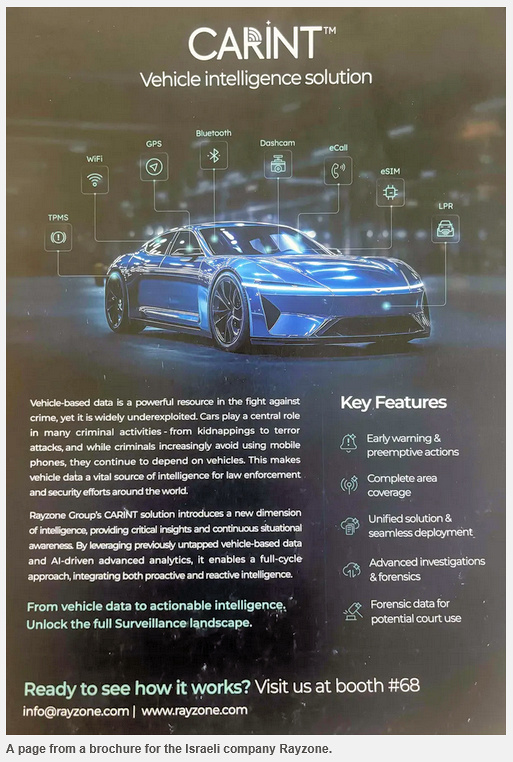
Another firm, Rayzone, offers a CARINT product that feeds the data it can collect from a car into a system that provides Rayzone’s clients with “full intelligence coverage” of the target under surveillance. The vehicle is just one of many data points being tracked by the firm. By analyzing location data and travel patterns, the technology allows governments to track targets using the SIM cards installed in the car while monitoring the vehicle’s wireless and Bluetooth communications. The tech also cross-references with roadside cameras to identify license plates and other data possessed by government agencies. This is part of a wider trend in which cyber intelligence firms are “fusing” data, not just collecting it.
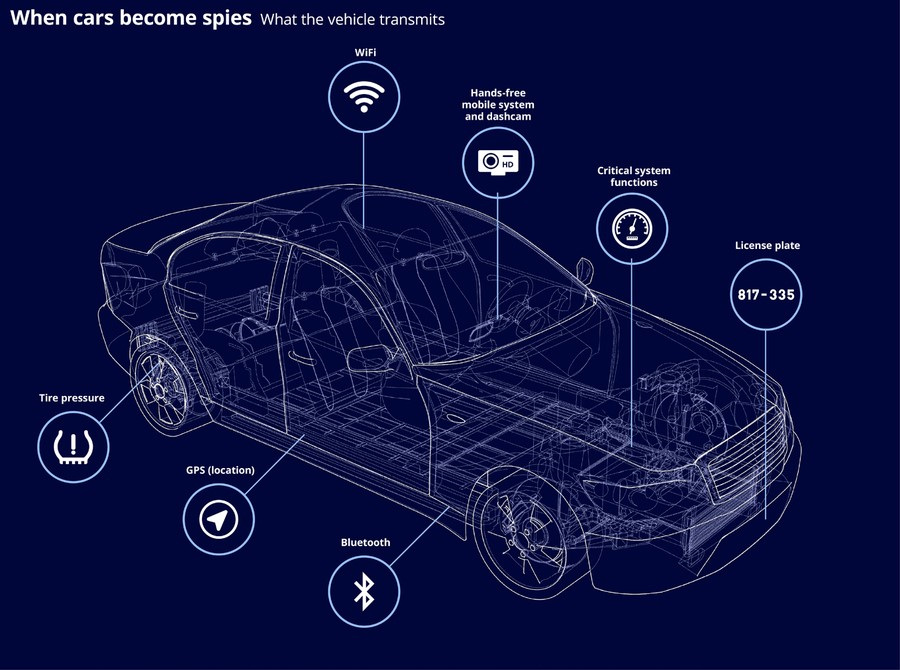
Modern cars feature a raft of computerized components that allow manufacturers remote oversight of critical systems, from braking to airbags. Built-in SIM cards provide constant connectivity for navigation, multimedia and features like remote starting of the engine – and that’s even before mentioning GPS systems and the systems connecting directly to our smartphones. That is a lot of information.
Of course, once this CARINT is collected, it has to be processed. Rayzone does its own data fusion and processing, but many other companies use the ubiquitous (and honestly scary) firm of Palantir, or another Israeli company called Cellebrite (currently favored by many law enforcement agency in the United States). For example, in September 2025, the Department of Homeland Security renewed an $11 million contract with Cellebrite for software which can unlock phones and take complete images of all data on the phone including apps, location, history, photos, notes, call records, text messages, WhatsApp messages, and encrypted messaging app data including Signal. Again, keep in mind that a modern car is little more than a cell phone on wheels. The technology used to hack your phone can also hack your modern car.
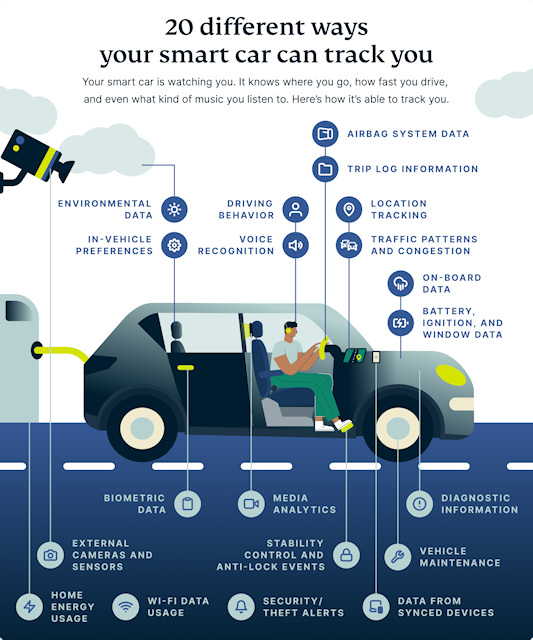
What cars are we talking about? Unfortunately, almost any vehicle today with wireless or blu-tooth capability. Under the aegis of “targeted marketing” found in their user agreements, all major auto manufacturers, foreign and domestic, gather CARINT. One of the most egregious, in my opinion, is Nissan: In its privacy policy, Nissan U.S. explicitly states that it collects and shares sensitive data such as sexual activity, health diagnosis, and genetic information for targeted marketing purposes. However, the policy doesn’t clarify how this information is obtained in the first place.
Another heinous example is Tesla: Between 2019 and 2022, Tesla employees inappropriately shared “highly invasive” videos and images recorded by customer car cameras. Why? For entertainment—employees created memes and shared “funny” clips. Tesla vehicles are equipped with extensive camera systems—typically eight external cameras plus an interior cabin camera. Sentry Mode uses these to record incidents around parked vehicles. The footage was supposed to be stored locally on the car. But employees clearly had access to footage that went beyond what Tesla publicly disclosed. If they can get to it, you better believe the Israeli firms and their covert op customers can too. And similar camera systems are found in all EVs now. The next time you walk up to a Tesla on the street, glance at the big screen on the dashboard. You will see it has registered your proximity. In fact, you are being recorded.
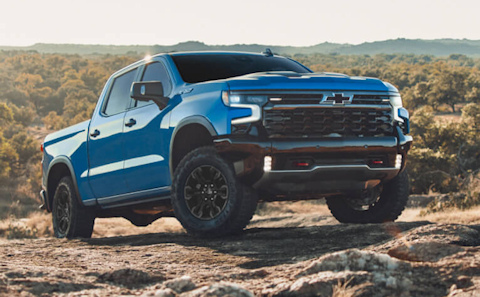
Even bread and butter American vehicles are guilty. The top-selling truck in 2023 was the Chevy Silverado. Due to its advanced telematics capabilities, it actively gathers a wealth of data on both the driver and the vehicle’s operations. This data collection covers personal details like names, addresses, and email addresses. It also extends to biometric markers such as fingerprints or facial features, all while keeping tabs on the driver’s whereabouts. Though the policy’s wording regarding synchronized phone data can be convoluted, the vehicle crafts user profiles based on individual driver habits and preferences. It leaves no stone unturned, even logging infotainment system use, from radio to rear-seat entertainment.
In addition to these details, the Silverado logs specific information like battery status, ignition details, window operation, gear status, and diagnostic information. It tracks the driver’s journey, recording location, route history, speed, and noteworthy driving events like braking, swerving, and cornering.
Regarding data sharing, the Silverado divulges information to affiliates within the General Motors network, third-party service providers, insurers, and government agencies. However, the policy leaves a question mark on whether data is shared with data brokers, as the manufacturer neither explicitly affirms nor denies this in its policy.
Even the venerable Ford F150 is guilty. Ford keeps tabs on speed, pedal usage, and even seatbelt engagement. The vehicle acts as a silent recorder, documenting routes, speed, and even local weather conditions.When it comes to sharing, Ford isn’t shy. They disseminate data to affiliates, service providers, insurers, and government bodies.
So— What can you do?
There are some steps that can be taken to limit the amount of data being collected on you. The first is the most obvious: drive an older vehicle that lacks internet connectivity and cameras.
The data collection firms that spy on your vehicle also troll social media. Be mindful of the information you share, especially on social media platforms or when communicating with friends and family. Avoid disclosing sensitive details about your smart car, such as its location or your travel plans on social media, and rather opt for messaging platforms that have end-to-end encryption like WhatsApp or Telegram.
Interestingly, an emerging trend in the automotive industry mirrors the competition between open-source Android and closed-source iOS in the smartphone realm. Look for car manufacturers that offer open-source options, enabling users to have greater control over their car’s operating system and, consequently, their data privacy.
In your contract when purchasing a vehicle, refuse consent for personalized advertisements to prevent the sharing of your personal information for targeted marketing. Think about it: if the marketing is targeted, they are gathering information on the target— you. Likewise, opt-out of information sharing.
Here’s a big one: Before selling or trading in your car, ensure you conduct a factory reset to erase all personal data and disconnect any associated apps. The same goes for purchasing a used car—confirm that the previous owner has removed their connected account.
In short, sadly, with your automobile you must exercise the same caution regarding personal data that you would with any other electronic device: keep software up to date to avoid hacking, change passwords, disable location sharing, reconsider using “voice assistants” that are obviously listening to you.
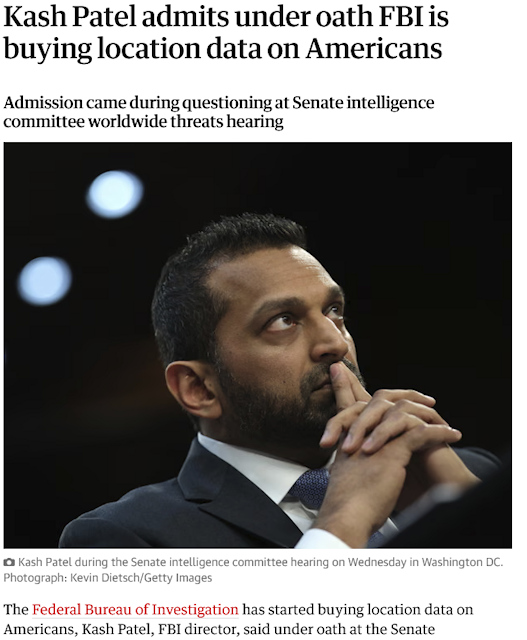
Remember the old adage: if the product is free, you are the product. Israeli spy firms are collecting data on American drivers and offering it to whomever will pay for it. They’re favorite customers are American intelligence agencies and police forces. For example, the FBI recently admitted it is buying location data on Americans. When questioned last month about the practice, Director Patel said, “We do purchase commercially available information that’s consistent with the constitution and the laws under the Electronic Communications Privacy Act, and it has led to some valuable intelligence for us.” Yeah, I bet.
Why does the FBI and other intelligence agencies purchase the data? Simple, while law enforcement must get a judge-authorized search warrant to obtain location data directly from telecom companies, government agencies have instead been able to buy such information from private data brokers. All made possible by companies based in Tel Aviv.
Keep the preceding information in mind when participating in the ANP’s “Spring Blitz” campaign this year, wherein Members and Supporters are encouraged to distribute flyers and other pro-Party and National Socialist information. If possible, use a vehicle that cannot be hacked and tracked.
Amerika Erwache!
SUBSCRIBE TO THIS BLOG
(It’s free, and mostly painless)



Leave a Reply